Showing posts with label novels. Show all posts

Tuesday, April 26, 2016

WIN SOME CASH!!!


Join us for the 41st Southeastern Writers Workshop, June 17-21, and you can submit any or all of our contests ~ for FREE!


Register for one day or all four ~ there's no minimum requirement!  And there a so many contests to choose from!  Do you have a novel, a short story?  Maybe humor, inspirational or personal narratives?  No matter!  There's a contest for you!  And best of all...

Every contests awards CASH PRIZES!!

2016 CONTESTS:
  • The Hal Bernard Memorial Award for Novel
  • The G.T. Youngblood Award for Short Fiction
  • The Vega Award for Speculative Short Fiction
  • The Julie L. Cannon Award
  • The Bill Westhead Memorial Award
  • The Angel Award for Holiday Seasonal Writing
  • The Thomas Max "You Are Published" Contest
  • The Award for Excellence in Inspirational Writing
  • The Humor Award

The submission DEADLINE IS May 15, 2016.  

Read the full guidelines on our website.


41st Southeastern Writers Workshop 
June 17-21, 2016 
Epworth by the Sea 
St. Simons Island, Georgia


Tuesday, March 15, 2016

Would you like to attend the 41st Southeastern Writers Workshop TUITION FREE?


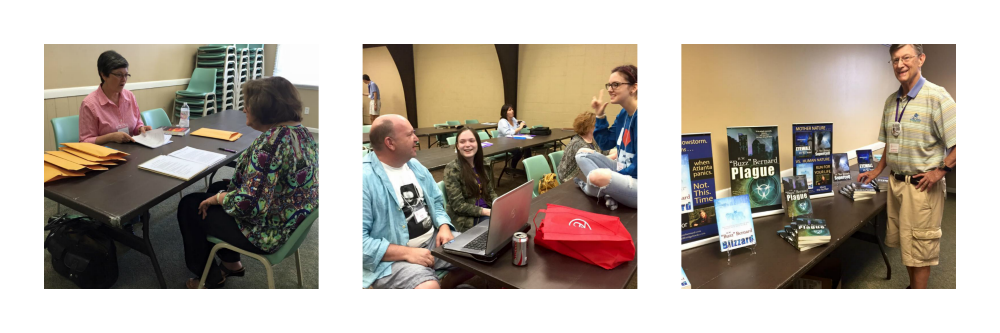
You could be here!


Win one of two scholarships to the SWA Writers Workshop!


Here’s how to enter:

  • Student Writer: ages 15-25 and enrolled in high school or college.  If the student writer is under 18, a parent or guardian must accompany him/her.
  • Adult Writer: age 18 or older
  • Submit a 500-word essay describing your journey as a writer and how attending the 41st Southeastern Writers Workshop will change your writing life.  Include why you are the most deserving of the scholarship.  Student Writers must include the name of their school or college.
  • The entry deadline is midnight on April 18th. Please email your entry to purple@southeasternwriters.org with a subject line of SWA Student Scholarship or SWA Adult Scholarship.
  • The scholarship pays for tuition only.
  • Winners will be announced May 1st


Why you should attend the 41st Southeastern Writers Workshop:
  • Full access to Jeanie Loiacono, CEO and President of the Loiacono Literary Agency, and Bob Babcock, Founder and CEO of Deeds Publishing
  • Specialty classes: Screenwriting, Young Adult, Marketing and more
  • 3 free manuscript critiques by our faculty of award-winning writers
  • Contests with cash prizes
  • Sell your books in the Workshop Bookstore


Tuesday, March 8, 2016

Join Us For Four Of The Best Days Of Your Writing Life!


41st Southeastern Writers Workshop ~ June 17-21
Epworth-by-Sea ~ St. Simons Island, GA


REGISTER TODAY!


Our Faculty includes:


Agent-in-Residence: Jeanie Loiacono, CEO and President of the Loiacono Literary Agency
Publisher: Bob Babcock, Founder and CEO of Deeds Publishing
Keynote Speaker: Janet Sheppard Kelleher, author of the best-selling Big C, little ta-ta

Novel Writing with Shamus Award Winner David Fulmer
Nonfiction Writing with Jedwin Smith, a 2-time Pulitzer nominee
Plus…
Young Adult Fiction: Michele Roper (a.k.a Gillian Summers)
Screenwriting: Michael Lucker
Commercial Writing: Peter Bowerman (a.k.a. The Well-Fed Writer)
Marketing: My Write Platform

Other Features:


FREE Manuscript Critiques!
Contests with CASH prizes!


Scholarships Available! ~ purple@southeasternwriters.org for details

Tuesday, February 16, 2016

ReBlogs: How A Novel Is Conceived


I grew up in western Oregon.  It seemed, at least in terms of natural threats, a bucolic place in which to spend my youth.  For instance, severe thunderstorms and tornadoes there were about as common as the Northern Lights in Georgia.   Hurricanes were nonexistent.  Such storms are born over warm oceans.  If you’ve ever dipped a toe into the Pacific along the Oregon coast, you know it’s water in which Polar Bear Plungers could train even in August.

There were the occasional big winter storms, of course.  But they certainly didn’t bear the DNA common to the meteorological monsters that inhabit other parts of the nation.  I did, incidentally, experience the Northwest’s “Big Blow” in 1962 that hurled winds over 100 mph into Portland.  Scary, but hardly Cat-5 stuff.

We’d get decent snowstorms once in awhile, too.  But true blizzard conditions were rare (see Northern Lights comment above.)

Earthquakes?  I recall a decent little shake in the late ‘40s, but Northwesterners didn’t dwell on such things....


Read the remainder of Buzz's article.


H.W. “Buzz” Bernard is a best-selling, award-winning novelist. His novels include Blizzard (the most recent), Eyewall, Plague and Supercell.  Buzz is a native Oregonian and attended the University of Washington in Seattle where he earned a bachelor’s degree in atmospheric science; he also studied creative writing.  He’s currently vice president of the Southeastern Writers Association.  He and his wife Christina live in Roswell, Georgia.

Tuesday, February 9, 2016

41st Southeastern Writers Workshop: Contests with Cash Prizes!!!


All attendees of the 41st Southeastern Writers Workshop are eligible to enter our many contests.  And you can write just about anything you want: novels, short fiction, essays, funny stories, true stories, stories with a Southern flair, stories set in other worlds!  And best of all....

There is MONEY to be WON !!!


Contests include:
  • The Hal Bernard Memorial Award for Novel 
  • The GT Youngblood Short Fiction Award
  • The Vega Award for Speculative Short Fiction 
  • The Julie L. Cannon Award
  • The Bill Westhead Memorial Award
  • The Angel Award for Holiday Seasonal Writing
  • The ThomasMax “You are Published” Contest
  • The Award for Excellence in Inspirational Writing
  • The Humor Award 


Contests are open to attendees ONLY.  Click here to learn more and to register.

Tuesday, January 26, 2016

To Share with Your Readers: Tips for Writing Amazon Reviews


Penny C. Sansevieri, is the CEO and founder of Author Marketing Experts, Inc. and internationally recognized as a book social media marketing and book marketing, and a media relations expert. She frequently offers tips and advice on marketing books on Amazon.


As an author I always, always try to encourage my friends to post amazon reviews for books they’ve read. I remind them that reviews matter to authors. Most, however, aren’t familiar with writing amazon reviews or have never written one.

Another issue, I’ve heard from numerous authors who have friends who post amazon reviews, for which they are grateful, but wished they were more detailed. Many times the reviews consisted of not much more than “Loved this book!” And while it’s great to have fans, amazon reviews like that do little to help a book along. Also, shorter reviews are often frowned upon by Amazon and could get pulled if the review seems disingenuous. Read more about why Amazon reviews get pulled.

When a book has lots of great, detailed reviews, we tend to scan them for highlights on the things that matter to us. That’s how we often buy books. Both good and bad reviews can help us decide, and, frankly, I’ve often bought a book after I read a bad review because what the reviewer didn’t like was exactly what I was looking for. That’s why detailed reviews are not only helpful, they’re a must for your Amazon page.

It’s tempting to ask friends and family to write reviews. They often want to help but aren’t sure what to say. And you may have readers who love your work but aren’t savvy on posting reviews.


Tuesday, December 15, 2015

Reblogs: The Two Most Powerful Words That You Can Say To Yourself While Writing

(from io9.com)


“I’m bored.” 

These two words are the hardest thing to admit, when you’re writing your deathless novel, or screenplay, or short story. You’re supposed to be creating a work of timeless brilliance. How can you be bored?

But admitting that you’re bored is the first step to not being bored.

The power of boredom


A lot of writers get really good at pretending that we’re not bored, and it’s possible to get so good at pretending that you even convince yourself that you’re interested in what you’re writing, when you’ve actually checked out a while ago. We put so much energy into motivating ourselves to keep writing, to put words on the page at all costs, that it can be a huge nightmare to admit that what we’re writing is actually not that fun or interesting. It feels like a terrible betrayal.

And a lot of writing advice boils down to “If you get bored, just keep writing until you find your way through it.” Or ways to cover up your boredom, or work around it, or distract yourself from it. Just taking a beat and saying “This is boring” feels as though it goes against the “just write a crappy first draft” ethos.

Tuesday, December 8, 2015

Getting A Clear Read


Picking a reader takes more than handing your manuscript off to the next person you see.  A reader can be instrumental in the success of your writing so choose carefully.

First, you need someone who is an avid recreational reader.  The higher the book count the better because he won't differentiate between your manuscript and the book he just bought today.  Someone who reads in multiple genres and mediums is good too, such as mainstream fiction, magazines and the daily newspaper.  This person knows what sits on the store shelves and can evaluate how your work will play within the current trends.

Second, an effective reader can explain the reasoning behind his opinions.  How many times have you handed a manuscript to someone and only to have the person say, “Oh I like it “ or “It’s not my favorite”?  That doesn’t help when you're trying to figure out if the ending gives the payoff promised or simply stops the story.   There must be some give and take with both sides questioning each other.  You have to feel comfortable with your reader to ask why does he think that and to play a game of "what if..."  with him. 

Third, honesty is the most important issue in the writer-reader relationship.  The risk of hurting your feelings may keep the people closest to you from giving you an honest critique.  Ask yourself, "I can trust him with my life, but can I trust him with my manuscript?"  On the flipside, struggling through life together can strip away all pretenses making your soulmate or your best friend the perfect reader.  He knows you and how you work and you know him.  Any inkling of sugar-coating would be spotted right away.  As your friend, he wouldn't betray the trust you placed in him when you turned over your manuscript.

Next you need to decide if a reader is necessary for you.  Look at your limitations.  I have a hard time seeing simple mistakes, not only in my work but in whatever I read.  My mind automatically corrects the mistake and I read through it.  Readers can spot basic errors and typos because they read with fresh eyes.  They can tell you what works, what to fix and what to cut out.  

I also have a habit of "writing short" for the sake of the word count, sometimes sacrificing clarity.  When you research a project, you learn far more than you'll ever put in your manuscript.  As a result, you may leave out information inadvertently because you know what you're talking about.  You know the backstory.  A reader can point out areas where your 1000 words don't add up to a picture for those outside your brain, and he can work with you to get your point across without busting the word count. 

It may be that you'll find a need for more than one reader.  Different people give different perspectives even when they're looking at the same manuscript.  Life experiences, interests and education all influence how a person looks at the written word.  Two people may like the same things but for different reasons.  They may pick out the same problem area, but offer differing solutions.  Of course, you could get critiques that make you wonder if you even gave them the same manuscript.  In any case, they'll both give you something to think about.

If you write in different mediums, it can be helpful to have different readers for each.  A reader who enjoys fiction might find nonfiction boring, while a nonfiction reader might not pick up on the nuances and subtleties of fiction.  Another way to split your reading needs is between grammar and content.  One can read for sentence structure, grammar errors and spelling, much like a copy editor, while the other handles the big picture of content and flow.  Then there's the availability issue.  If your deadline looms and your reader is on vacation, having a second reader available saves you that risk of submitting a flawed manuscript.


Deciding on the need for a reader is personal.  If you're already selling every word you write, you might not need a reader.  If your sales are sporadic or if you find yourself bogged down in revisions unable to let anything go, an effective reader can help.  So evaluate your career honestly, recognize recurring problems, then look for someone with the traits and skills to give your next manuscript a good read.


Tuesday, November 24, 2015

ReBlogs via Indies Unlimited: Almost Everything You Need to Know about ISBNs


Are you considering self-publishing your book? 


Laurie Boris, a freelance writer and indie author, is a regular contributor to IndiesUnlimited.com and she recently discussed the how-to's and what-for's about ISBNs.


One of the most frequent questions I’ve heard lately from self-publishing authors is about ISBNs. Do you really need them? Do you really need to buy them? What are the pros and cons of buying an ISBN versus using the free or inexpensive ones offered by CreateSpace, BookBaby, Smashwords, and other online partners? Let’s see if we can clear that up some.

First, a little background


ISBN stands for “International Standard Book Number.” Early iterations began in the 1960s as a system for booksellers to better organize and track their inventory. Books published before 2007 have ten digits in their ISBNs. Books published after January 1, 2007 have thirteen digits.


Read the remainder of Laurie's article.

Tuesday, November 17, 2015

ReBlogs: The Author’s Abyss


It occurs every time I complete a manuscript and send it out for comment.  I can’t explain it.  It just happens.  I tumble into something I call "The Author’s Abyss", a sinkhole of self-doubt.  It’s recurring epiphany I have that, in plain language, reminds me I can’t write worth a shit.

I realize the beloved project–my novel–that I dove into with such enthusiasm and optimism has disintegrated into something worthy of only a paper shredder.  In the beginning, full of passion and fervor, I commanded, at least to myself, “Let there be light,” and a fictional world full of interesting characters and compelling stories began to take shape out of a formless void.  Pulitzer Prize-candidate stuff.

But by the time I’d spread my incompetent hand over the dark waters, and sent my baby out to “finishing school” for critique and comment, I knew beyond a shadow of a doubt there was no Pulitzer in my future.  Probably not even a cheap ribbon for participation.


H.W. “Buzz” Bernard is a best-selling, award-winning novelist. His novels include Blizzard (the most recent), Eyewall, Plague and Supercell.  Buzz is a native Oregonian and attended the University of Washington in Seattle where he earned a bachelor’s degree in atmospheric science; he also studied creative writing.  He’s currently vice president of the Southeastern Writers Association.  He and his wife Christina live in Roswell, Georgia.